When an elastic body is subjected to large deformations a multi-well strain energy function is often involved to model the
mechanical behavior of the material appropriately. Essentially this means that the strain energy function is not rank-one
convex and the corresponding Euler-Lagrange equations are not elliptic. This adds computational and numerical analysis challenges, for the
former suitable minimization techniques are required, while for the latter tools from the calculus of variations with new proposed schemes are
needed. Here various numerical schemes are proposed from general convex, to multi-well strain energy functions (first online version for the later finding
in December of 2024). The suggested numerical schemes have the property that the discrete minimizer of the continuous problem converge to a minimizer
of the continuous problem as the discretization parameter goes to zero, i.e
\(\int_\Omega W(\nabla y_h) \rightarrow \int_\Omega W(\nabla y), \text{ as } h\rightarrow 0\)
where \( y_h \) minimizes the discrete problem and \( y \) minimizes the continuous total potential energy.
To accomplish the above result the theory of \(\Gamma- \)convergence is used. Furthermore, for specific elastic energies
a generalization of the embedding theorem for Orlicz spaces, to the piecewise polynomial spaces admitting discontinuities were
required.
In the geometrically nonlinear theory of elasticity it is well known that under specific boundary conditions
minimizing sequences arise, forming finer and finer microstructures in order to satisfy continuous deformations with
discontinuous deformation gradients, where the deformation gradients belong to the energy wells.
To understand better the behavior of the discrete minimization process we construct a two well (modulo rotations)
elastic energy. Mimicking the austenite-martensite transitions, more precisely
cubic to orthorhombic transformation, we choose the lattice parameters such that perfect interfaces are formed for the normals n=(1,0),
n=(0,1), in the sense that continuous deformations with discontinuous deformation gradients at the energy
wells are allowed along these normals.
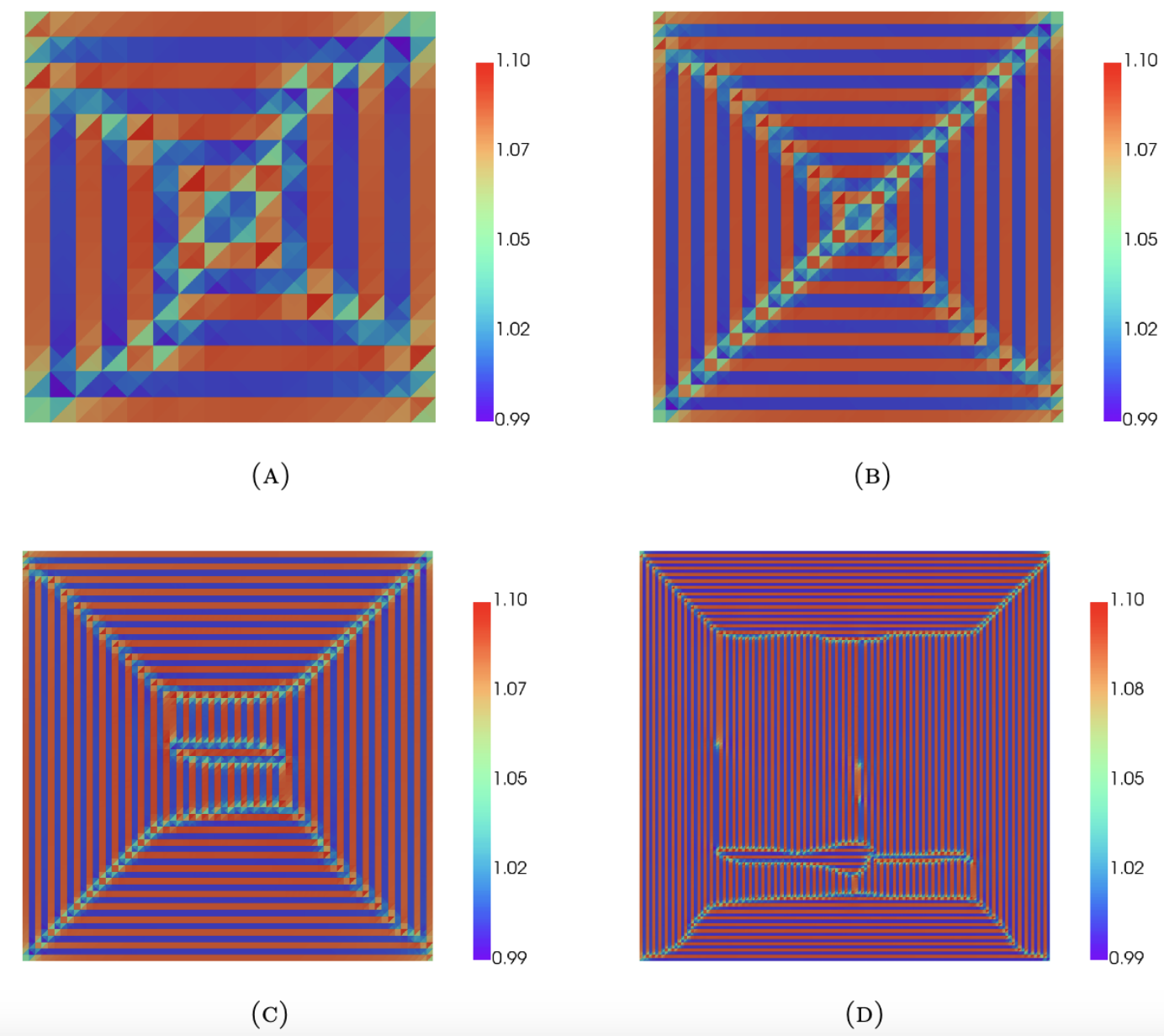
Figure below: Discrete minimizers where red, blue colors indicate the attained phases orthorhombic,
cubic respectively. The elastic energy is zero everywhere except the transition layers (green colors).
Finer microstructures emerge for finer mesh resolution. Essentially the discrete minimizers capture elements of
a sequence \(\{ y_k\} \in W^{1,\infty}(\Omega)\) such that
such that \( y_k\stackrel{\ast}{\rightharpoonup} y_0\) in \(W^{1, \infty}(\Omega) \)
where \(\{ \nabla y_k\} \) generates the unique homogeneous Young measure
\(\nu_x = 0.5 \delta_I + 0.5 \delta_V\). We show that \(y_0\) is the minimiser of the relaxed problem.
See https://doi.org/10.48550/arXiv.2501.11944.